

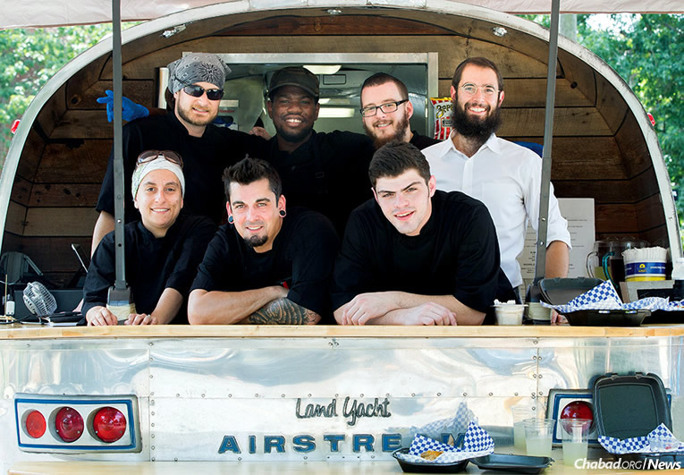
Aryeh’s Kitchen is gearing up for a tasty year ahead.
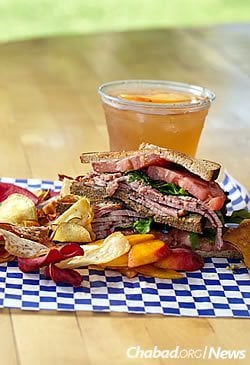
Since May, the full-service campus kosher food truck has been serving gourmet meat meals at Vanderbilt University in Nashville, Tenn. Modern Southern delicacies such as slow-cooked brisket, chicken-and-waffles and BLT sandwiches (using glatt-kosher pastrami) have been causing a stir among students, faculty and the community at large.
“My grandmother cooked kosher food when I was growing up, but I don’t recall ever seeing a piece of meat that wasn’t dry, overcooked and gray,” says Ken Freeling, a New York City attorney whose 21-year-old son Zack is a rising senior at Vanderbilt. To bring the project to fruition, the Freelings partnered with Rabbi Shlomo Rothstein, director of the Rohr Chabad House at Vanderbilt. “We wanted to make awesome food that was hip, relevant and appealing to college kids, and, of course, delicious. We want to turn kosher food into the best they’ve ever had—kosher or not.”

Rothstein says the university—home to more than 1,000 Jewish students—has been tremendously supportive of the initiative, granting Aryeh’s (Zack Freeling’s Hebrew name) Kitchen a permanent spot to park in the center of campus. It is the only food truck allowed on the premises during dining hours and the only non-cafeteria food on campus at all, for that matter. Food may be purchased with money or with campus dining dollars through the university’s dining services.
Julia MacKendrick, a pre-nursing senior from Chicago, has ordered food three times since recently returning to campus for classes. To date, she has eaten the chicken tacos, herb-poached chicken wrap, and the brisket with onions and horseradish aioli.
“It’s all so good. You don’t always think of super-fresh food coming from a truck, but this food is so fresh that it feels like I’m sitting down in a really nice place to eat,” says MacKendrick, who is not Jewish and hadn’t eaten kosher food prior to these meals. “They don’t skimp on any details or cut any corners. Everything tastes so good—like it came right off of the barbecue. I even heard someone say, “Oh man, I have to start keeping kosher!’ ”
‘Ignite the Divine Spark’
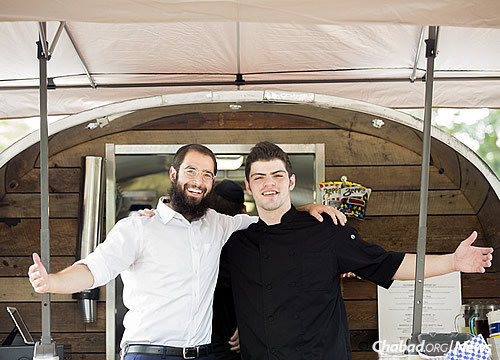
The burgers, sandwiches, wraps and salads are served from a modified 1971 Airstream trailer. Ken Freeling clarifies that most of the food is prepared ahead of time in an off-site commissary kitchen under the watchful eyes of two rotating mashgichim (kosher supervisors).
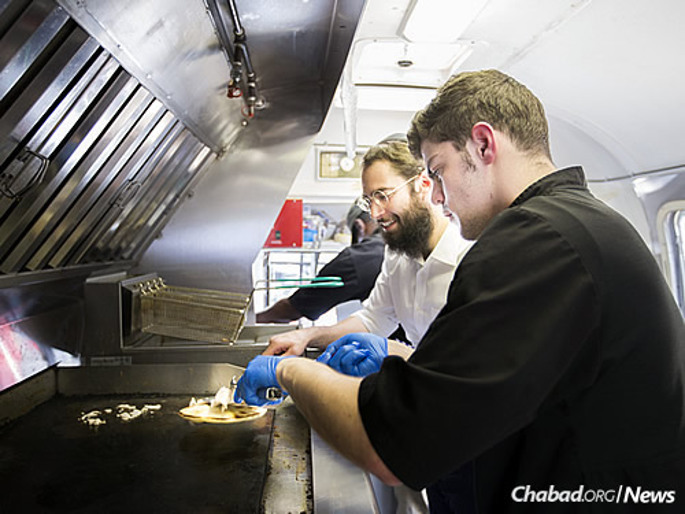
“The food truck is intended to extend Chabad’s mission by not only serving kosher meat meals to people who are observant, but to create an experience that combines the mind, body and spirit,” explains Ken Freeling, who notes that the nearest kosher meat restaurants are in Memphis or Atlanta, both a good three hours away. “When you eat this terrific food, you will, if even for a moment, feel a connection to something spiritual. It’s a nice reminder of Jewish identity and a true binding experience for Jewish souls, giving them a real taste of Chabad. What we’re trying to do is ignite the Divine spark within each person.”
Freeling worked closely with a chef to develop recipes that featured traditional Jewish food to be prepared in a way that would put it high above any other foods available, whether kosher or not. For example, Aryeh’s Kitchen’s brisket is slow-cooked for nine hours, shredded and steamed to lock in moisture, and then finished off on a grill to add crispness. It is served with sauces, spices, herbs, aiolis and chutneys—condiments not usually associated with traditional Jewish food—to add flavor and appeal. The menu also changes depending on the time of year; for example, during the Nine Days before Tisha B’Av, when the consumption of meat is forbidden, the menu included fish tacos and ceviche. As the High Holidays approach, the menu will include honey-sweetened dishes, apple-infused offerings and other traditionally infused fare.
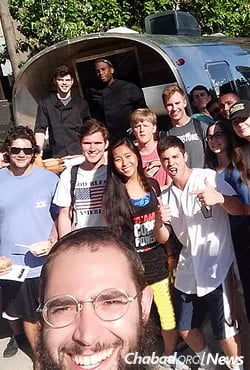
“The student population has responded well so far; they really love it,” says Zack Freeling, who devotes many hours a day to running, organizing, working in and supervising the truck’s operations. “The community has been incredibly supportive of this whole project, and it has really shown me how important it is to have kosher food in Nashville. It is helping us educate the public about kosher food that connects the eater to a ‘Higher Authority.’ I hope that the truck will continue to be welcomed with open arms by the students, administration and community, as they become more educated as to what kosher is and about what the Chabad House stands for.”
Each meal served from the truck comes with a card offering messages meant to uplift and inspire people from all backgrounds. There are even future plans to offer free meals for customers who perform acts of kindness as an extension of the mission of the Lubavitcher Rebbe—Rabbi Menachem M. Schneerson, of righteous memory—and the philosophy of Chabad Houses, which work to provide meaningful Jewish experience to all who enter. And the Freelings note that a kosher-supervisor internship is being developed, with components for study, work and learning, using the truck as a business model.

‘A Jewish Touchstone’
Zack Freeling had just begun his freshman year at Vanderbilt in the fall of 2013 when he received the devastating news of the passing of his brother, Sam. Ken Freeling, who was on business in the Middle East at the time, helped his son contact the university chaplain’s office for support, where he was directed to Rothstein. Despite never meeting Freeling previously, Rothstein dropped what he was doing to comfort the grieving student.
“Rabbi Shlomo came to me within minutes, and ever since then I have been very close to him. We have built a very strong relationship,” says Zack Freeling, a human-organizational development major and entrepreneur. “He is very warm, and he gave me words of wisdom to ease my mind on such a difficult day. Even now, he checks in with me to see how I’m doing, and we meet with each other regularly to talk about what’s going on.”
That same year, Ken Freeling visited Zack at Vanderbilt for the Passover seder, which was held at Chabad under a banquet tent and attended by more than 150 students. It was the first time that the elder Freeling met Rothstein.

“I was amazed by what the rabbi was like. Even though I had grown up in Brooklyn, I never knew much about Chabad other than seeing the mitzvah mobiles around the city,” says Freeling. “People come to Chabad because it’s full of joy, happiness and wisdom. The students are drawn to this environment to get respite from the stresses of being a student. I saw this with my very own eyes.”
Over the years, Rothstein and the Freelings have developed a strong bond. The elder Freeling says his life has been greatly inspired by his Jewish learning and connection to Chabad.
“Chabad, in my view, is unique,” says Ken Freeling. “It really personifies the Jewish message of the importance of celebrating life, and finding the joy and happiness in it. We want to give anyone and everyone an opportunity to experience Chabad and its mission to bring goodness into the world—basically, reminding human beings of their humanity.”
Since that first seder, whenever Rothstein visits New York, he makes sure to visit with Freeling. (He has even accompanied him to the Ohel, the Rebbe’s resting place in Queens, N.Y.) They learn Chassidic philosophy in person or over the phone weekly, and Freeling has become involved in supporting the Rohr Chabad House at Vanderbilt financially.
During one lunch meeting, the pair was discussing ways in which to expand Chabad’s mission and reach. “We were discussing how to provide something that people want to be a part of and love to go to on a regular basis,” recalls Rothstein. “We wanted to create a Jewish touchstone, to help people benefit from Jewish interaction without having to walk into a building or commit to taking a class. We wanted to find an easy way for students to have regular interactions with something Jewish and to reach as many students as possible. We wanted to create something that would have the same impact as a big event, like a seder. The Rebbe constantly spoke about the importance of providing kosher food for college students.”
The rabbi had long been trying to bring kosher food to campus, and Zack Freeling maintains a love of food and cooking. As a result, they created the idea of the food truck and developed a presentation for a partnership with Vanderbilt. After it was accepted, Ken Freeling funded the entire startup operation. The truck’s opening event was a kosher-catered seder on campus this past spring for hundreds of students.
“It’s amazing how strong Ken feels about the good that we’re going to be able to do with this truck,” says Rothstein. “This is not my project that he’s helping me with; it’s very much Ken and Zack’s project, and we’re a team. The spirituality of the project is also very much theirs. They’re not supporting it from the outside; they’re a major part of the team in making this happen. They’re leading and driving it of their own accord.”
Aryeh’s Kitchen is open year-round for breakfast and lunch Sunday through Thursday, from 8 a.m. to 3 p.m.; with late-night hours on Thursdays, from 10 p.m. to 3 a.m.





Join the Discussion