

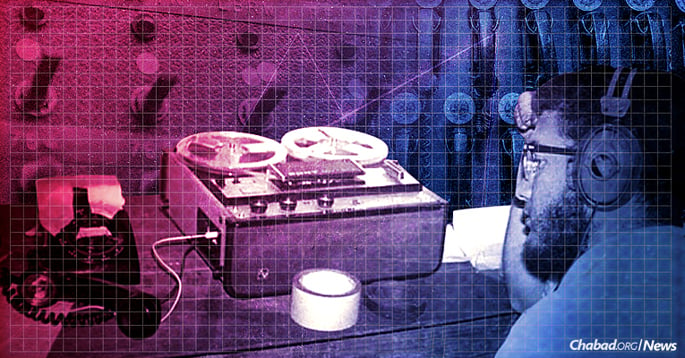
This is the story of how a handful of young Chassidim set out to build a global communications network in the era before Periscope, Skype, VoIP, or even satellite or Cable TV. Their actions would sow the seeds for dozens of future Chabad-led forays into digital communications.
As Shabbat ended and the Sabbath peace faded on Saturday, Jan. 17, 1970, there was a palpable sense of excitement on the ragged streets of Crown Heights, N.Y., the Brooklyn neighborhood that’s home to Chabad-Lubavitch World Headquarters. The previous decade had not been kind to residents. Crime rates had shot up. Blockbusting had led to so-called “white flight,” as rapidly shifting demographics and the general malaise that had begun to afflict New York City in the Lindsay administration took hold. Once home to Jews of all backgrounds, only Lubavitcher Chassidim—many of them survivors of the Holocaust and of Soviet oppression—remained en masse as a Jewish community, a harden bulwark against what locals perceived as a communal collapse.
That Shabbat, however—the 10th day of the Hebrew month of Shevat and the day preceding it—was decidedly different.


At 38 degrees, the weather was relatively balmy for mid-winter, and the streets thronged with thousands of Chassidim. More than 100 guests had arrived from Israel, with even more from Jewish communities in Montreal, Los Angeles, London and beyond. It was the 20th yahrtzeit (anniversary of passing) of the Previous Lubavitcher Rebbe—Rabbi Yosef Yitzchak Schneersohn, of righteous memory—and the date that his successor, the Rebbe—Rabbi Menachem M. Schneerson, of righteous memory—assumed the mantle of leadership for the Chabad-Lubavitch movement.
When the Rebbe delivered his first discourse 20 years earlier, the Chabad community in the Western Hemisphere numbered in the dozens. Under his guidance, the movement had blossomed, with some 100 Chabad Houses (outposts of Jewish observance and life) opening in communities and on college campuses large and small to serve Jews around the world.
That Friday had seen the completion of the “Sefer Torah to Greet Moshiach,” a Torah scroll begun by the Previous Rebbe in 1942. Though the majority of the scroll had been written relatively quickly, its completion had languished; by 1970, the project was all but forgotten. The week before, however, the Rebbe had announced that the Torah would be completed on Friday afternoon, the ninth of Shevat, and that a grand dedication would be held.

Instead of the normal hustle-and-bustle of preparation before Shabbat, that Friday the challahs had all been baked, the chicken already roasted and the matzah-ball soup put up the night before. Everyone was to be found at 770 Eastern Parkway, Lubavitch World Headquarters. In a first for the Rebbe, a photographer was brought in to officially document the day’s proceedings. Also for the first time, after Shabbat the Rebbe’s talk at the farbrengen (Chassidic gathering) would be broadcast live through a phone-line hook-up to 1,000 Chassidim gathered in the village of Kfar Chabad, Israel.
This early work done by a handful of yeshivah students in Brooklyn would ultimately serve as a catalyst for the Chabad movement’s expansion across the world of popular and digital media. It sowed the seeds for dozens of future Chabad-led projects, including the earliest roots of what has become the largest Jewish-content website to date: Chabad.org.
‘Publicity Through the Radio’
The need to promulgate Jewish thought and teachings via modern technology has deep roots in Jewish history. The mention of Jews involved in the nascent art of printing in Europe pre-dates Gutenberg and the Hebrew texts of Rashi’s commentary on the Torah, as well as the halachic treatise the Arba’ah Turim, which dates to 1475, making them Incunabula—the earliest works of the printed word.
In the 1940s, enterprising Chabad Chassidim in America and Israel began discussing Judaism on the radio. Among those shows were lectures on the Tanya (the seminal work of Chabad philosophy), begun in January 1960 on WEVD, The Forward’s Yiddish radio station.
The Rebbe encouraged the endeavor shortly after it began, drawing parallels to the Zohar’s reflection on the wellsprings of Divine and secular knowledge as a precursor to the Messianic era: “There is publicity through writing and print . . . there is publicity through speech . . . but the possibility of publicity through the radio is doubly advantageous. . . . The voice does not weaken, but reaches the ends of the earth with the same vigor with which it left the mouth of the speaker.”
As the Rebbe’s emissaries traveled around the world—founding Jewish communities from Los Angeles to London to Melbourne, Australia—the demand to hear the Rebbe’s talks increased. Though his talks were transcribed and printed in pamphlets, and unofficial reel-to-reel recordings were swapped among friends, Jewish communities around the world yearned to take part in the farbrengens in real time.
The idea of broadcasting the Rebbe’s weekday talks was broached as early as 1959 as an extension of the radio broadcasts on Tanya and other Chassidic works by Rabbi Yonah Eidelkopf in Israel. The Rebbe rejected then, saying “the time has not yet come.”
In the weeks leading up to the 20th anniversary of the Rebbe’s leadership, yeshivah students in Israel, unable to fly to New York, broached the idea of creating a phone hook-up with the yeshivah’s staff. The Rebbe was approached, and permission was granted. The talks would be heard around the world.
Chassidic Hackers
The original broadcast was arranged by three Israeli yeshivah students, all in their 20s, who were studying in Brooklyn. Mulik Rivkin, Chaim Boruch Halberstam and Meni Wolff showed an innate technical aptitude, as well as the dedication to set the project up in the evenings and early mornings before the talk.
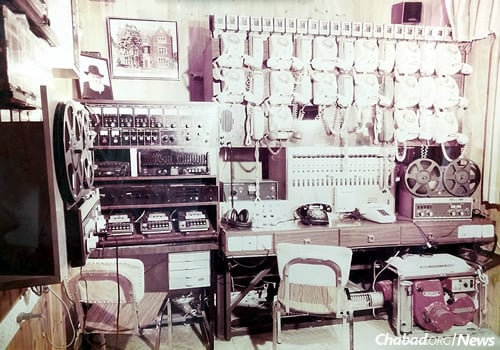
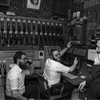
Their first task was to find a place in 770 to serve as command central, their center for operations. One of the small rooms near the back of the long corridor that forms the spine of 770 had a small window that looked down on the large synagogue beneath it, and more critically, had a phone line.
After the successful broadcast to Israel, other communities clamored to take part in future phone “hook-ups.” Yonasan Hackner, for example, was an English student studying in the Chabad yeshivah in the Parisian suburb of Brunoy, France. “As soon as we heard about the hook-ups,” he recalls, “we immediately started thinking about how we could have them as well.”

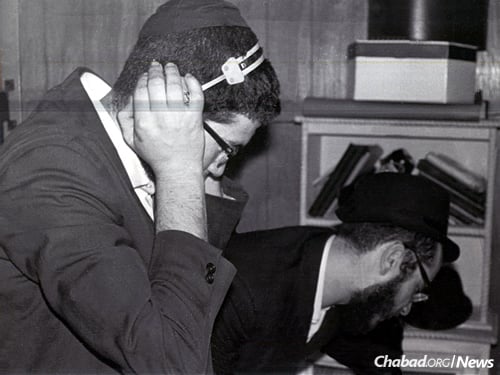
Eliezer Kalman Tiefenbrun, a local artist, began experimenting with HAM Radio and other technologies to try and bring the “hook-up” in London. He reached out Hackner for technical advice.
Together, they cold-called Halberstam in New York and began making plans to broadcast the Rebbe’s talk a month later—on Purim—in London.
In the era before Periscope, Skype, VoIP, or even satellite or Cable TV, such actions were nothing short of revolutionary.
Back then, phones in the United States (not merely the line, but the hardware itself) were owned by the communications conglomerate Bell System. In England and Israel, as well as elsewhere abroad, the phone lines were run by the national post-office system. Many aspects of phone utilization were highly regimented and mired in bureaucracy. Long-distance calls, for instance, had to be arranged in advance with the phone company, booking time beforehand with an operator. And the fee was considered prohibitively expensive, with a direct call to Israel costing $3.50 a minute in 1970.
At the same time, the 1970s were considered the “Golden Age of Phreaking”—the exploratory phone “hacking” at the cutting edge of communications. Meeting at homebrew computer clubs, future tech luminaries such as Apple co-founders Steve Jobs and Steve Wozniak, and Microsoft co-founder Bill Gates, all had their start at this rudimentary form of hacking.

It was in this cultural milieu that a handful of Chassidic hackers sought to cobble together a working phone system to transmit the Rebbe’s talks live across the globe.
That said, Halberstam and Hackner had a number of technological hurdles to address. Even after securing the funds and booking long-distance time with an operator, they needed to ensure that the audio could be played clearly to the groups assembling in London. In addition, Hackner would be returning to France for yeshivah, so the decision was made to transmit London’s hook-up to there as well.
Hackner approached a telephone agent for advice, who said that while it technically possible to attach a phone line directly into a speaker, it wasn’t officially allowed.
Afraid to take apart the phone, Hackner and Halberstam experimented with various means of connecting microphones to the phone’s speakers. Talking long-distance, they bandied about ideas across the Atlantic for days on end and late into the night. “We had teams of yeshivah students in Montreal, South Africa—all over the world trying to build a better hook-up system,” says Hackner.

Initial attempts included using ACE bandages and even sink plungers to join the two.
“When I finally did take apart my phone,” recalls Hackner, “I was shaking.” In the end, they created a system that hardwired the signal from the phone into local sound systems.
In order to transmit the call further, a phone in one of the London Chabad House offices was left off the hook to pick up the audio playing on the building’s intercom.
For the actual Purim talk, Hackner was back in Brunoy. Sound equipment was sourced in Paris, and given the six-hour time difference between London and New York, late that night the students gathered in the yeshivah’s study hall.
“The audio equipment kept picking up radio waves from a local French channel, and the audio was rather tinny,” recalls Hackner, “but to us, it was amazing. We were on a high!”
Jewish communities in London, Israel, France and Montreal had been able to unite with the events taking place in Brooklyn, N.Y.
‘On the Phone All Night’
After that, additional communities expressed interest in joining. Regional hubs were quickly set up, so that the connection from London to New York could be routed to such cities as Manchester, Birmingham, Leeds and Glasgow, as well as to France and Israel, where it would be rebroadcast to Jerusalem, Tel Aviv, Kiryat Malakhi in the south and beyond. In time, the office in London routed three-quarters of the hook-ups, including lines to South Africa and Australia.
Each community was responsible for raising funds to cover their hook-up, as well as towards general operating expenses. A six-hour farbrengen then could cost upwards of $1,250 (the equivalent of about $7,800 today) and would only begin at 1 o’clock in the morning in London.
On one occasion, Hackner recalls a bewildered English operator sitting until 6 a.m., trying to figure out why people in London were taking part in a seemingly one-way call to New York.
“Whenever the Rebbe would pause from speaking,” says Hackner, “the operator would ask us if the call was over. We told him to read a book or take a nap—that we’d be on the phone all night.”
Phone trees were even set up in larger communities in Israel, London and France to alert people to “surprise” talks by the Rebbe.
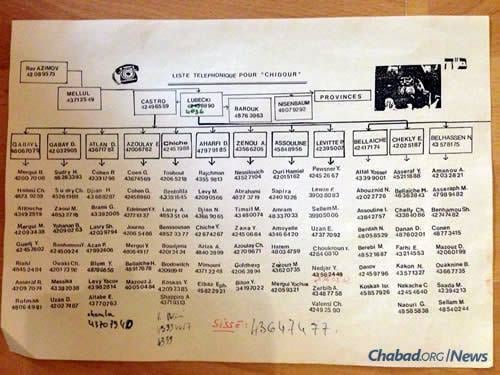
On Oct. 6, 1970, a new level of innovation was attempted as well: A two-way line was established, allowing the Chassidim gathered in Kfar Chabad not only to hear the Rebbe speak, but respond to his toast of l’chaim as well.
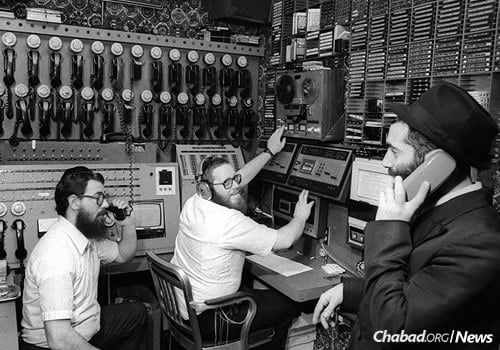
Halberstam in New York continued to expand the infrastructure to operate the hook-ups. Dubbing the operation “World Lubavitch Communications Center”—with the acronym WLCC, and the tagline “spreading Judaism via all means of audio and visual communications”—additional phone lines were added to the room. By the end of 1970, eights lines were set up to broadcast the talks.
“The actual room still had only one physical line,” reports Halberstam. “In order to meet the sudden demand, wires were run from around the building and even from neighboring homes.”
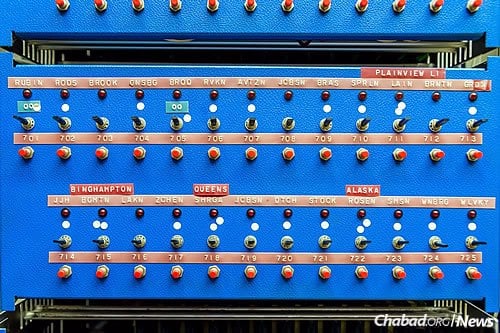
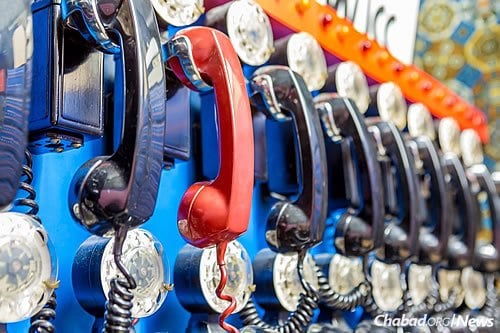
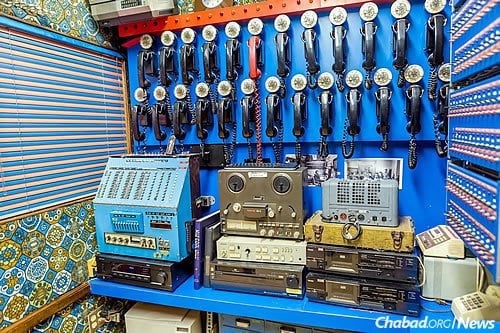
Some 420 phone lines were ultimately run from the phone company directly into WLCC. In turn, these lines served as regional hubs to hundreds of other countries, cities, communities and private homes.
In 1972, an equalized phone line integrating radio-quality audio was installed, allowing a team of translators to give a simultaneous running translation during the Rebbe’s public weekday talks in as many as four languages over shortwave radio. The lines had the added benefit of potentially allowing the Rebbe’s talks to be broadcast over the radio.
“The Rebbe told us that he wasn’t yet ready for his public talks to be broadcast on the radio,” said Halberstam. A year later, however, the Rebbe consented.
Soon, the Rebbe’s weekday farbrengens, in addition to radio shows hosted by Rabbis J.J. Hecht and Yosef Wineberg, were broadcast over the radio on time purchased from WEVD. The radio broadcasts happened so frequently that ultimately, the mixing was done by the staff of WLCC and sent directly to WEVD’s offices at 770 Broadway. The room was also put to use during Jewish Educational Media’s live satellite broadcasts of farbrengens, and the “Chanukah Live” broadcasts in the 1980s and ’90s.

Spreading Light Around the World
Beginning in the 1980s, the “hook-up” room went through vast technological innovation.
In 1982, an automated system was built by Halberstam to directly connect people calling in to the live feed, without the need to manually connect the lines. Until that point, if a call was dropped or disconnected, the line would remain open in WLCC, effectively making it impossible to dial back in. Halberstam did the research, investigating various options used by telecommunications firms, and developed a method incorporating a password system. It also included 100 lines for on-demand call-in Torah lectures, as well as video and audio equipment to record and copy the events in the Rebbe’s court.
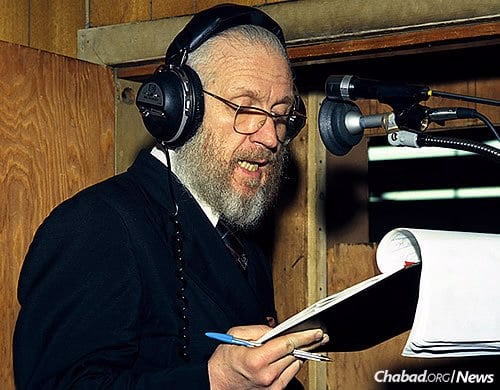
By 1992, requests for additional phone lines came into the phone company so frequently that when work was being done on a nearby street, some 500 potential lines, in addition to fiber-optic cables, were run directly to 770. In total, 420 lines were ultimately installed, reaching 600 locations around the world.
“It was a massive undertaking,” acknowledges Halberstam. To meet the demand, additional staff members were hired. Among them was Rabbi Yosef Yitzchak (Y.Y.) Kazen, who began collecting and cataloging private recordings of the Rebbe’s earlier talks.

WLCC served as the de facto communications hub for the Chabad movement—not only broadcasting the Rebbe’s public talks to hundreds of communities around the world, but also documenting the day-to-day happenings of the Rebbe’s court. Remote-control cameras were installed to capture people meeting the Rebbe to receive “Sunday Dollars,” and a cadre of microphones was purchased to record the Rebbe’s various talks, no matter where they took place in the synagogue.
During farbrengens, each segment would be recorded immediately and copied to tapes, allowing people to purchase tapes of the talk as soon as it had ended.

WLCC also served as a virtual incubator for many of the Chabad movement’s future forays in media and communications. The work of Eli Winsbacher—creating phone hotlines for on-demand Torah classes—continues at the Heichal Menachem center in New York; the audio and video recordings of the Rebbe’ talks have been incorporated into Jewish Educational Media’s central archive; and the pioneering work of Kazen and Winsbacher on on the early internet would evolve into the Chabad.org website in 1993.
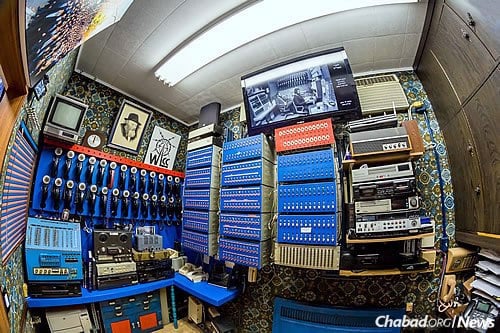
In recent years, the room has been re-imagined as a visitor center for the thousands of people who tour 770 every year.
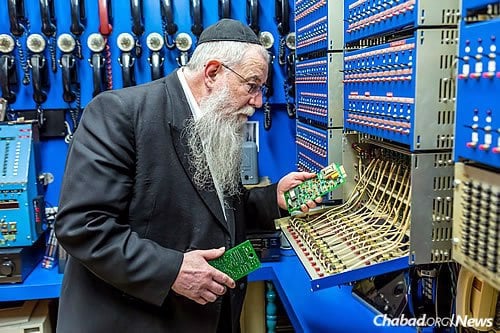
Halberstam still works in the room, welcoming guests and allowing them to explore artifacts from video and audio, past and present.
“We greet hundreds of people each week,” he says. “The room continues to serve as a way of uniting communities from around the world. It’s the Chabad House for 770.”
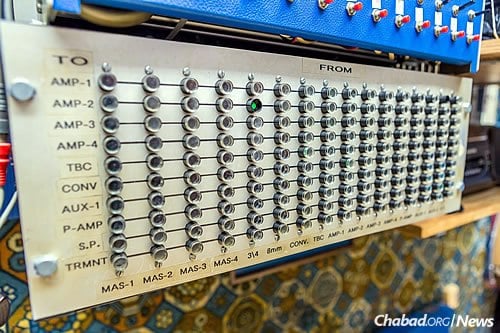
Though retrofitted with a glass display case and computer equipment, the original switchboards and phone systems still remain.
Reflecting on the room, Hackner recalls: “It was a wonderful sight to behold. All of the switches would be lit and flipped, so it glowed like it was Chanukah in July . . . and you just knew that from this little room, such a powerful message was going out to the entire world.”







Join the Discussion