


As rockets rained down on cities throughout Israel, the Knesset held a special session on Tuesday to honor—and gain strength from—the faith, Torah, and legacy of the Rebbe, Rabbi Menachem M. Schneerson, of righteous memory.
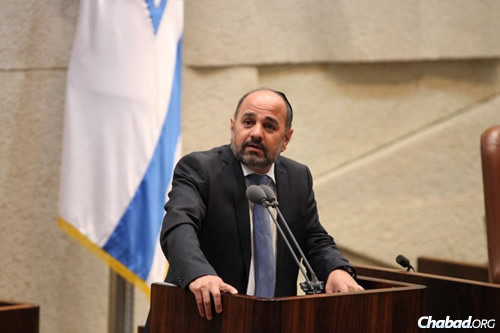
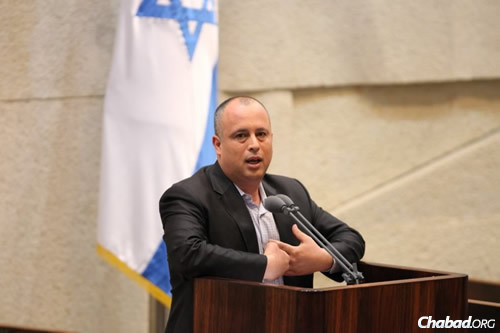
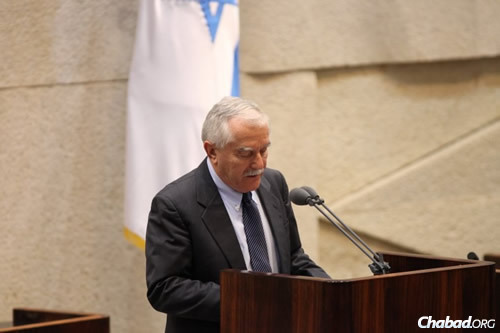
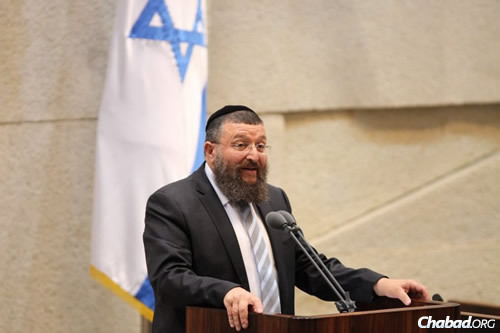
Many of the 19 parliamentarians and ministers from across the political spectrum who spoke during the program shared personal memories of how the Rebbe influenced their lives. They also noted how the Rebbe’s legacy continues to inspire and invigorate the Jewish nation 20 years after his passing.
Typical of the Israeli parliament, almost all of the speakers struggled to fit their remarks into the three minutes allotted to them. However, unlike most sessions, those in attendance and those who were unable to attend were simultaneously occupied with the escalating national crisis that involved every Knesset member and virtually every committee.

The late afternoon session was opened by Speaker of the Knesset and former refusenik Yuli Edelstein. “It is hard to put into mere words the debt that the Jewish nation owes this one person. I can stand and speak for hours about my long connection to Chabad [and the Rebbe],” said Edelstein who learned about Judaism in the midst of Communist oppression. “I can tell about my [clandestine] wedding [that was arranged by the Rebbe’s emissaries], about the tefillin that were smuggled to me in prison and more. The amazing thing is that so can many other members of the Knesset.”
“Wherever you go in the world,” said the next speaker, Yakov Margi of the political party Shas, “you encounter places that 40, 30, 20 years ago were desolate deserts—in the physical and spiritual sense—places where people would not want to live, then came the Lubavitcher Rebbe and transformed them from the Sinai Desert into Mount Sinai, making the desert bloom in a spiritual and social sense.”
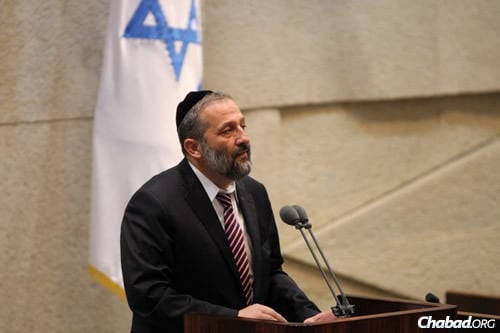
“I was amazed,” said Aryeh Deri, leader of the Shas Party, “at the activities of Chabad all over the world. It’s unbelievable that it’s the result of the efforts of one person.”
Ruth Calderon, representing the Yesh Atid party, spoke about how “the Rebbe wanted to reach every Jew wherever he is and raise him up in Judaism. It was technically impossible, so he raised an army of young people and empowered them to represent him as an extension of himself. This bond—the product of the Rebbe’s singular leadership—empowered them to surmount impossible-seeming challenges.”
She then suggested that every Jewish person heed the Rebbe’s call and devote a number of years to service of their home communities or communities abroad, forming a “Jewish Peace Corps.”
In describing the network of shluchim—of Chabad emissaries—Yitzhak Cohen, who has served as a member of the Knesset for Shas since 1996, said the Rebbe created 4,000 points of light, spreading Torah and Judaism even in the hardest times. Taking his cue from the Ten Commandments, Cohen said that the 10 mitzvah campaigns that the Rebbe initiated encapsulate all 613 mitzvahs of the Torah.
He was followed by Menachem Eliezer Moses of United Torah Judaism, who described the Rebbe as the embodiment of the leader described by Rashi to the weekly Torah portion: “A leader who can carry each and every one according to his individual understanding.”
“The Rebbe’s love was one of personal sacrifice, and he inspired the same in others,” he said, sharing his experience in Warsaw, Poland, where he saw the Rebbe’s emissaries drawing close and uniting Jews from all sectors of society.
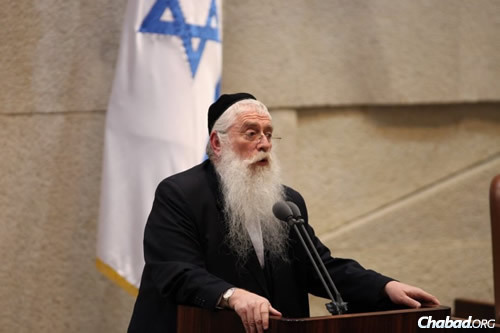
“What can I say in three minutes about the Rebbe, a giant among kings?” lamented Menachem Porush also of United Torah Judaism, who observed that the phenomenon of Chabad emissaries serving innumerable communities is something that “everybody knows about and benefits from, but no one can possibly describe. The Rebbe worked passionately to spread the wellsprings [of Torah and Chassidism]. It was important to him set up schools, the mitzvah campaigns, encouraging Jews to do mitzvahs, and more and more than can possibly be listed.”
In light of the unfolding military escalation, Porush reiterated the Rebbe’s call for Israel to remain strong and not to negotiate with terrorists, which he attributed to the current state of affairs.
Like many of the others, Shimon Ohayon—a professor at Bar-Ilan University in Ramat Gan and a representative of the Yisrael Beitenu party—drew from the events of the past few weeks, during which the entire nation of Israel rallied around the plight of the three kidnapped yeshivah students. “The Rebbe dedicated his time and effort to foster Jewish unity,” he said, “but from a place of joy and good-heartedness.
“Everyone was beloved and felt a personal connection when meeting the Rebbe,” Ohayon recalled, “But the Rebbe’s concern spread far beyond those of us who met him in person. He was connected with and updated on every community, from the largest to those with just a few individuals.”
‘The Center of Everything’
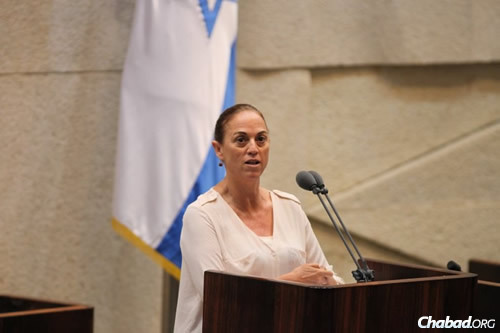
Shuli Moalem-Refaeli of HaBayit HaYehudi stressed the Rebbe’s trailblazing approach to the role of Jewish women in Judaism. “The Rebbe taught that women have a role that is important as that of men. The Jewish woman is the center of everything—the family, the spirit of Israel. The Rebbe would point out that our nation was redeemed from Egypt in the merit of the Jewish women, and the future redemption will also be in the merit of the women ... the Rebbe believed that without women, we cannot progress.”
Amnon Cohen, a member of the Knesset for Shas, shared his personal recollections of learning in the underground network of Judaic schools as a child in Uzbekistan, then part of the Soviet Union, and later, in the Chabad school in Rishon Letzion, Israel. Reflecting on how the Rebbe’s inspiration has fostered a Jewish resurgence in places where it had once been banned, he exclaimed: “The Lubavitcher Rebbe is alive and well!”
“The Rebbe was everyone’s Rebbe,” stressed Avraham Michaeli, also of the Shas party, who recounted with pride the names of the Georgian rabbis who were inspired and trained by Chabad emissaries in the early 20th century, forming a close alliance of communities that has continued until this day. “The Rebbe valued all people, Jews and non-Jews ... ”
Longtime leader of Shas Eli Yishai, who now serves as a Knesset member, recalled a similar experience in the Chabad school where he had learned as a child: “We were taught to love everyone and do for the community. That is how we were raised.”
Nissim Ze’ev, a member of Shas since 1999, cited the high esteem in which the Rebbe was held by two late chief Sephardic rabbis of Israel: Rabbi Ovadia Yosef and Rabbi Mordechai Eliyahu. Rabbi Yosef referred to the Rebbe as “one in his generation, with no equal”; Rabbi Eliyahu referred to him as “without brother or peer, a prince of Talmud, a prince of commentaries, a prince of Kabbalah and a prince of all areas of scholarship—a soul that unites all of Israel in the most amazing way.”
A speaker from the left-leaning Hadash party—introduced as “the Communist Dov Khenin”—went on to share his personal lesson: “Within every person, there is a spark of goodness, you just need to find it and coax it out ... during these times when many people are angry and bitter, this message [of the Rebbe] is salient.”
It All Begins With ‘I Believe’
Seeking to find the underlying theme of the Rebbe’s approach, Avi Wortzman, deputy minister of education and a member of HaBayit HaYehudi, quoted a 1972 letter the Rebbe had written to a childhood acquaintance who had left Torah observance. “I believe that you believe, that we both believe,” the Rebbe wrote. “With this ‘I believe,’ ” the Rebbe created a network of shluchim from Alaska to Thailand, and from Metula in the north [of Israel] to Eilat in the south. It all begins with his ‘I believe.’
“And it did not end with his passing. At the recent Conference of Chabad Emissaries, where I represented the government, I saw how Rabbi Kotlarsky asked all those who had went out as shluchim in the past 20 years after the Rebbe’s passing to rise, and 70 percent of the room stood up.
“As rockets are falling, we must mention the words that the Rebbe told the police chief at the time [of the Gulf War]: “These are not ‘tough times.’ Regarding Israel, the Torah states that it is a ‘land upon which G‑d has His eyes at all times.’ ”
David Rotem of Likud Yisrael Beitenu proudly shared his memories of meeting the Rebbe 30 years ago. “I will never forget the moment,” he said. “I saw how the Rebbe looked deep into me. He created bonds between the people he touched and the Creator of the World.”
He was followed by Yehiel Hilik Bar of the Labor party, who quipped that he was thankful for those who had spoken more than their allotted three minutes, thus biding him some time after finishing up a television interview about the unfolding military situation.
“I am not a Chassid and cannot even describe myself as religious,” said Bar, “but it is important for me to speak about the Rebbe. The Rebbe was a difficult person to describe in one dimension. He was a child prodigy in Torah learning and also a man with a far vision, beyond the here and now. It hurt him when someone else was in pain, both a Jew and a non-Jew. ... And this is what attracted people like me. If we want to describe him, he was a leader.”
“Twenty years have passed since his passing, but the Rebbe’s soul is still with us through his activities,” began Yair Shamir of Likud, who went on to share the deep connection that his father, former Prime Minister Yitzhak Shamir, enjoyed with the Rebbe, including what he described as his father’s amazement at the Rebbe’s underground activities in Russia. Turning to the current situation, Shamir remarked: “My father was greatly strengthened by the Rebbe’s assurances. During the Gulf War, the Rebbe assured us that Israel was the safest place in the world, and so it was.”
Shas representative Yoav Ben-Tzur affirmed the importance of the Knesset officially recognizing the Rebbe’s enduring contributions.
Summing up the evening’s talks, Deputy Minister of Religious Affairs Eli Ben-Dahan of HaBayit HaYehudi proclaimed: “Let us remember the Rebbe’s great legacy and truly learn, teach, keep, and most of all, do.”







Start a Discussion